

Lean Bulking Plan for Natural BodyBuilders

Lean Bulking is a strategic , long-term approach to muscle growth that involves maintaining a slight caloric surplus (typically 200-300 calories above maintenance) and eating nutrient-dense, whole foods to build maximum muscle while minimizing fat accumulation.It focuses on gradual weight gain (0.25-0.75lb/week) combined with high-intensity resistance training to avoid the excessive fat gain associated with “dirty” bulking.
Why Lean Bulking is Best Option
Lean Bulking is considered superior because it maximizes muscle hypertrophy while minimizing fat gain through a controlled , slight caloric surplus (+300-500 calories) and nutrient dense, whole foods. This approach promotes better long term health , maintain a define physique and avoids the drastic unhealthy fat-loss phases required after “dirty” bulking.
Key Reasons Lean Bulking is Best
- Controlled Weight Gain & Fat Minimization : By limiting the caloric surplus, the body uses excess energy to build muscle rather than storing it as excess fat.
- Improved Body Composition & Health : Focuses on whole foods rather than processed food, which reduces inflammation and prevents negative health impact like high blood pressure or cholestrol.
- Superior Nutrients Intake : It emphasizes whole , nutrients-dense foods , which provides essential vitamins , minerals , and fiber prmoting better digestive health and lower more stable blood sugar levels compared to “dirty bulking”.
- Avoid Extreme “Cutting” Phases : By Keeping Body Fat low During the building phase , there is no need for a long , restrictive , and often muscle wasting cutting phase afterward.
- Better Energy and Performance : Sustain clean eating leads to better energy levels , improving better performance and recovery without the sluggishness associated with high sugar processed food intake.
NUTRITIOUS MEAL PLANNING AND DIET

A nutritious meal plan is the foundation of a healthy body, strong muscles, and high energy levels. Whether your goal is muscle gain, fat loss, or overall fitness, eating the right foods in the right balance is essential.
This guide will help you understand healthy meal planning, key nutrients, and a sample daily diet plan you can follow at home.
UNDERSTANDING BALANCED NUTRITION
Lean bulking is a strategic approach to muscle growth that involve building mass while strictly minimize fat gain , unlike “Dirty Bulking” which often leads to excess body fat. To do this you must consume a slight controlled surplus roughly 200-500 calories above your maintenance level and prioritize high quality whole foods.
Here is a guide to better balanced nutrition for a lean bulk, based on expert guidelines.
THE CALORIC STRATEGY

- Find Maintenance : Determine your TDEE(Total daily Energy Expenditure) to Establish your maintenance calories.
- The Surplus : Add a moderate 10-20% surplus(200-500 extra calories per day).
- Rate of Gain : Aim for a slow , steady weight gain of 0.25-0.5kg(0.5-1lb) per week.
- Adjusting : If you are not gaining weight increase your daily intake by 100-200 calories.If you are gaining more than 0.5 kg per week , reduce your calories slightly .
- Protein intake : Protein builds and repair muscles. General range is 1.6 – 2.2 g/kg (0.7 – 1.0 g/lb) of body weight. for ex- A 75kg (165 lb) person would aim for about 120-165 grams of protein. sources of protein- Chicken breast, turkey, fish, lean beef, eggs, cottage cheese, Greek yogurt. Supplements you can take is Whey protein powder (in shakes).
- Carbs intake :Your Daily target should be 4-7g of carbs per kg of body weight (e.g., a 70kg/154lb person needs roughly 280–490g daily). Consume the majority of carbs around workouts—before to fuel, and after to replenish.Sources of carbs- Prioritize whole foods , complex carbs like oats , brown rice , sweet potatoes , and whole wheat pasta to maximize nutrient intake.
MACRONUTRIENT BREAKDOWN
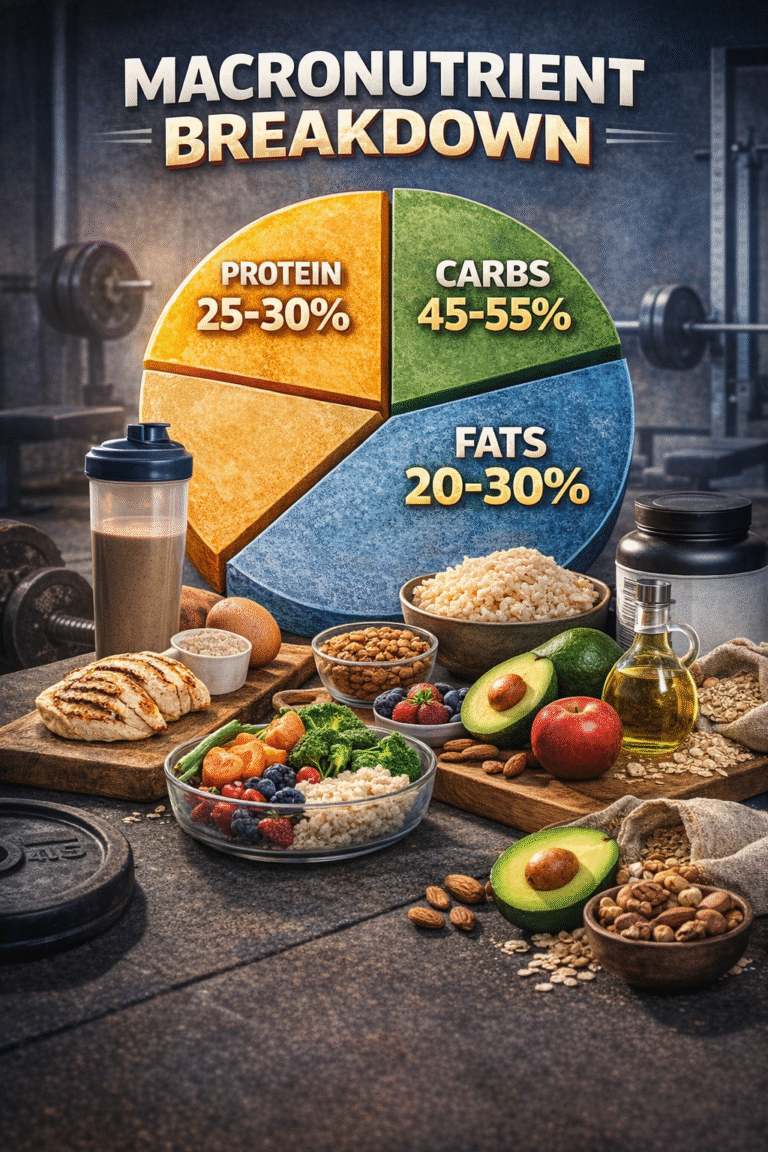
For an effective , lean bulk aim for 10-15% calorie surplus focusing on high quality nutrients to gain muscle while minimizing fat.A common successfull macro ratio is roughly 30% protein , 40-50% carbohydrates and 20-30% fats. daily targets generally include 1.0-1.2 grams of protein , 2-3 grams of carbs and 0.3-0.5 grams of fat per pound of body weight.
OPTIMAL MACRO BREAKDOWN FOR LEAN BULKING
- Protein(Muscle repair & growth) : 1.0-1.2 per lbof body weight( or 25-30 % of daily calories). Sources-chicken breasts , turkey , lean beaf , Fish , eggs , green yogurt.
- Carbohydrate( energy & Performance) : 2-3 lb of bodyweight ( 40-50 % of daily calories ). Sources- Oats , quinoa , brown rice , sweet potatoes , fruits , legumes.
- Fats( Harmone Regulation ):0.3-0.5 lb of bodyweighht( or 20-30 % of daily calories )
TRACK PROGRESS AND ADJUSTMENTS

Tracking Progress and making adjustments in a lean bulk ensures you are building maximum muscles with minimum fat gain. The key to a successfull lean bulk is targeting a weight gain of approximately 0.25–0.5 kg (0.5–1 lb) per week, or about 1% of body weight per month.
Here is a comprehensive guide to tracking and adjusting your lean bulk based on evidence based practices.
KEY METRICS TO TRACK PROGRESS
The Core Metrics
- Weekly Weight Trends (Daily Weigh-ins): Weigh yourself in the morning, on an empty stomach, after using the washroom. Do not focus on daily numbers, but on the weekly average to see if you are gaining at an appropriate rate.
- Goal: A gain of roughly 0.5–1 pound (or 0.25–0.5% of body weight) per week is considered ideal for a lean bulk.
- Performance Metrics (Strength Log): Use a training logbook to record all exercises, sets, reps, and weights. A consistent increase in strength in the gym (progressive overload) is a key indicator of muscle growth.
- Goal: If your weight on the scale and your strength in the gym are both increasing, you are on the right track.
- Body Measurements: Use a tape measure to track changes in your waist, chest, arms, and thighs every 2–4 weeks.
- Goal: The waist measurement is critical for ensuring you are not gaining too much fat. It should remain relatively stable, increasing by no more than 1 cm (0.4 inches) per month.
- Progress Photos: Take photos every 2–4 weeks in the same lighting, with the same poses, and in the morning to visually track changes in muscle definition.
HOW TO ADJUST BASED ON DATA
- If weight gain is too slow (<0.25% per week): Increase your daily calories by 100-200 , primarily from carbohydrates.
- If weight gain is too fast (>0.5–1% per week) or fat gain is excessive: Reduce your daily calorie intake by 10% and consider adding light cardio, such as 2-3 sessions of Low intensity steady state (LISS) per week.
- If strength stagnates: Increase calories slightly or reassess training intensity.
WHAT TO EXPECT
- Muscle Growth Rate: Beginners can expect about 2–3 lbs of muscle per month, while intermediate/advanced lifters will see much slower gains.
- Duration: A proper lean bulk should last 16–26 weeks, or even up to a year, for the best results.